Introduction
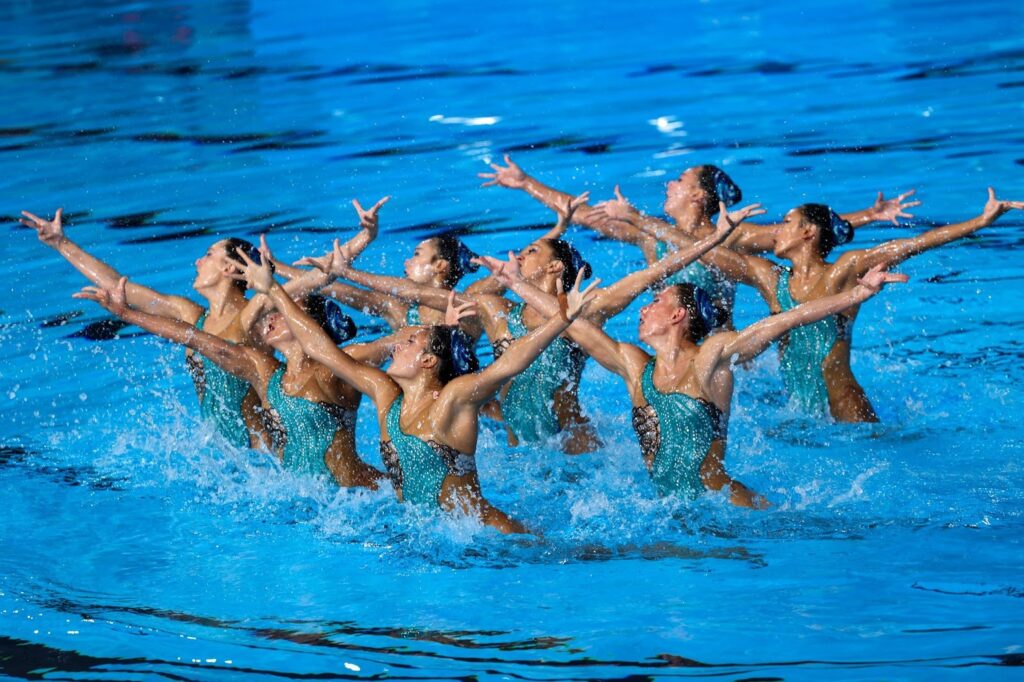
Artistic swimming is an incredibly beautiful sport, but if you’ve seen any videos, you may have noticed a significant change in the last few years. The structure of routines has shifted. Routines still feature showstopping choreography and amazingly fluid transitions, but all the teams seem to execute near-identical moves as soon as they go upside down. This is a manifestation of the sport’s new ruling system. Below is an explanation of these new rules and how artistic swimming is evolving in response to them.
Terminology
Before getting started, here is some good terminology to have on hand:
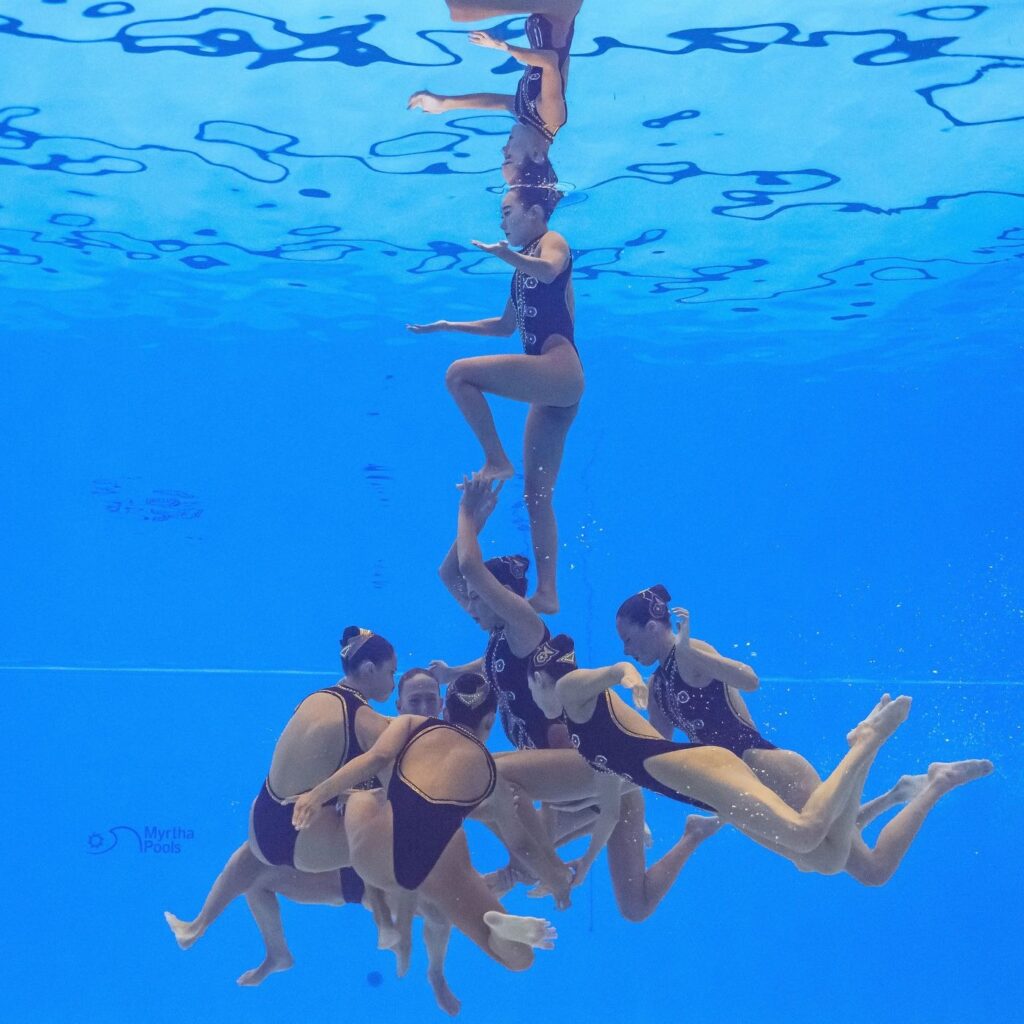
- Hybrid: A set of underwater movements where an athlete’s legs are in the air.
- Strokes / Transitions: When athletes are breathing and performing choreography with their arms and bodies.
- Acrobatics / Lifts: When athletes lift their teammates out of the water.
- Element: A hybrid or lift in a routine.
The General Idea
Previously, the rules were more opinionated. Judges would determine the score based on calculations in artistry and difficulty, but nothing truly defined how these categories were judged. This left major room for innovation in new artistic movements, but it also meant uncertainty in scoring, with no truly quantifiable justification for any given score. With the new rule changes, the artistry category retains the same general idea, but the difficulty score bears little resemblance to its previous form.
Structure of Routines
The major noticeable change that came with the new rules is the structure of routines: Routines all seem to follow a basic pattern, and underwater movements all kinda look the same. This has to do with new restrictions defining different types of routines. Older routines didn’t have many restrictions other than their length, so choreography could explore a combination of short and long hybrids, small and big lifts, and simultaneous above and below-water movements. Now, in addition to just a specified length, routines are constrained by a limit on their allowed number of hybrids and lifts.
Difficulty Chart
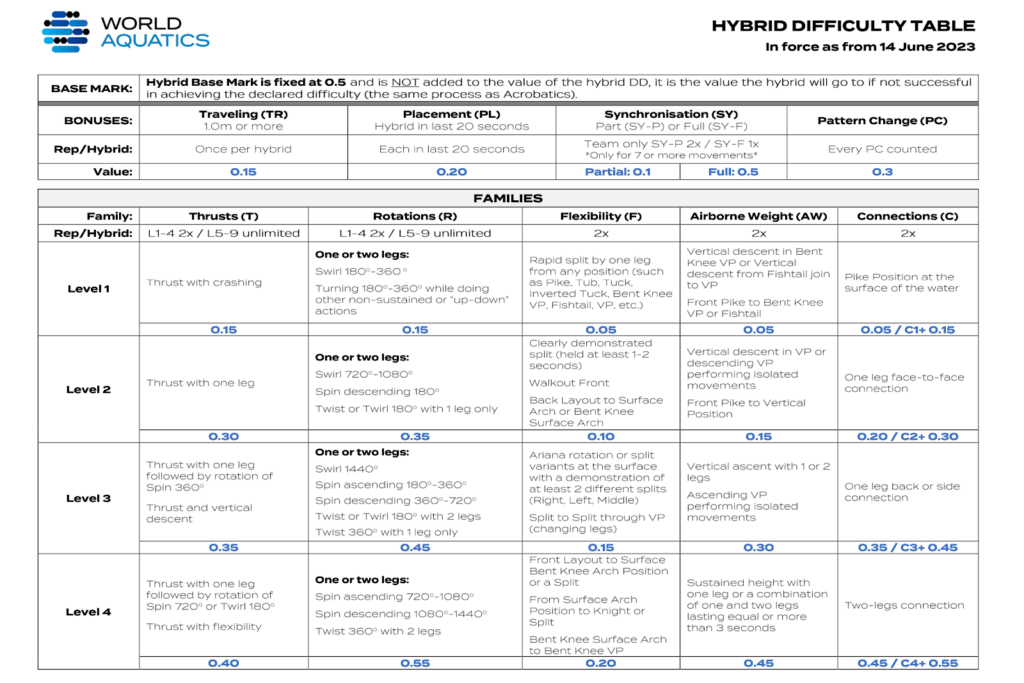
Out of everything, the most jarring change seems to be the difficulty chart. Before, difficulty was measured by many factors, including how long an athlete spent underwater, the difficulty of their strokes, and the complexity of their movements. Although this method better accounts for all factors that contribute to the difficulty of a routine, the lack of standardization makes scoring highly subjective. Now, with the introduction of the difficulty chart, the focus has shifted away from all that; difficulty is a more objective measure of how many points an athlete can earn.
The difficulty chart (partially shown below) is a set of movements that an athlete may perform during a hybrid, containing over 150 different options. These movements are for a wide range of skill levels, with each having a point value for its presumed difficulty. When forming a hybrid, athletes combine elements as they wish, keeping the basic structure needed to satisfy their descriptions but often also adding their own flair. The goal is to form a visually appealing routine while also collecting as many points as possible in the time allowed.
Acrobatics
The change in acrobatics is of a very similar notion to the change that occurred with the difficulty chart. The only real difference is that it has to do with lifts instead of hybrids. Acrobatic options are listed with their corresponding point value in the acrobatics catalog, where lifts are sorted by their setup (how a team pushes the athlete underwater) and the movements executed by the flyer (the athlete being thrown or lifted into the air). Athletes are able to compete the lifts specified in this catalog or also combine the positions and setups of different lifts to declare a new lift made of pre-existing parts. Additionally, depending on the age of the athletes in the routine, there may be a capped point value for each acrobatic move to ensure athlete safety. Although this seems like a huge change, visually, there isn’t much difference. This is because most teams would showcase similar styles of lifts, and the acrobatics catalog holds all of these general styles in addition to many more.
Methods of Judging
Four panels of judges are present when scoring routines: elements, artistic impression, synchronization technical control, and difficulty technical control.
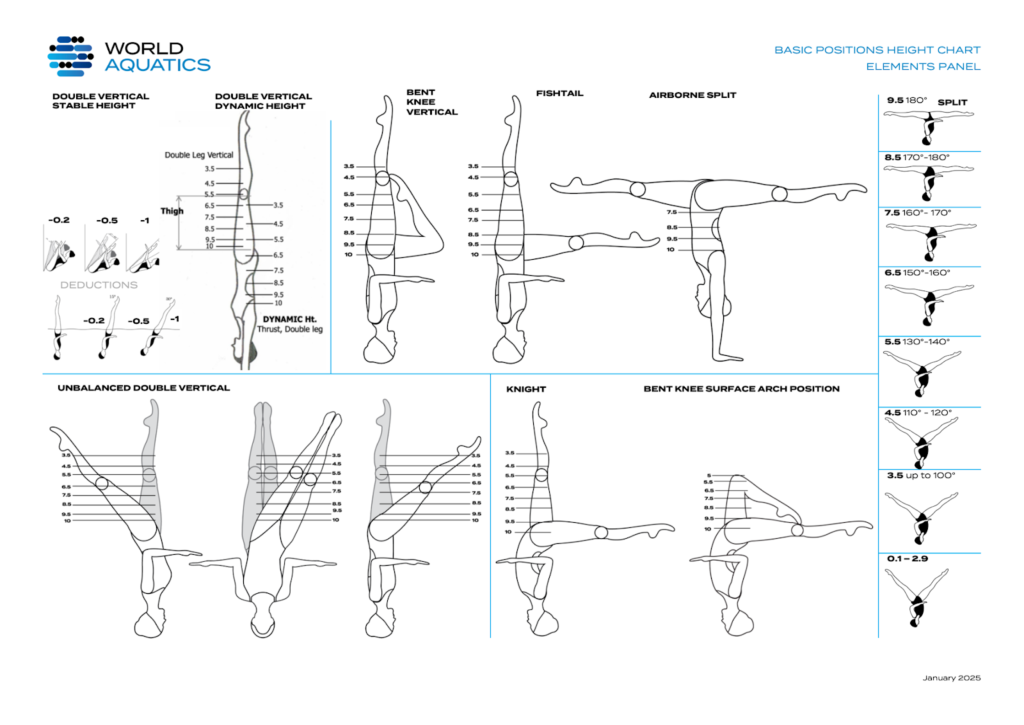
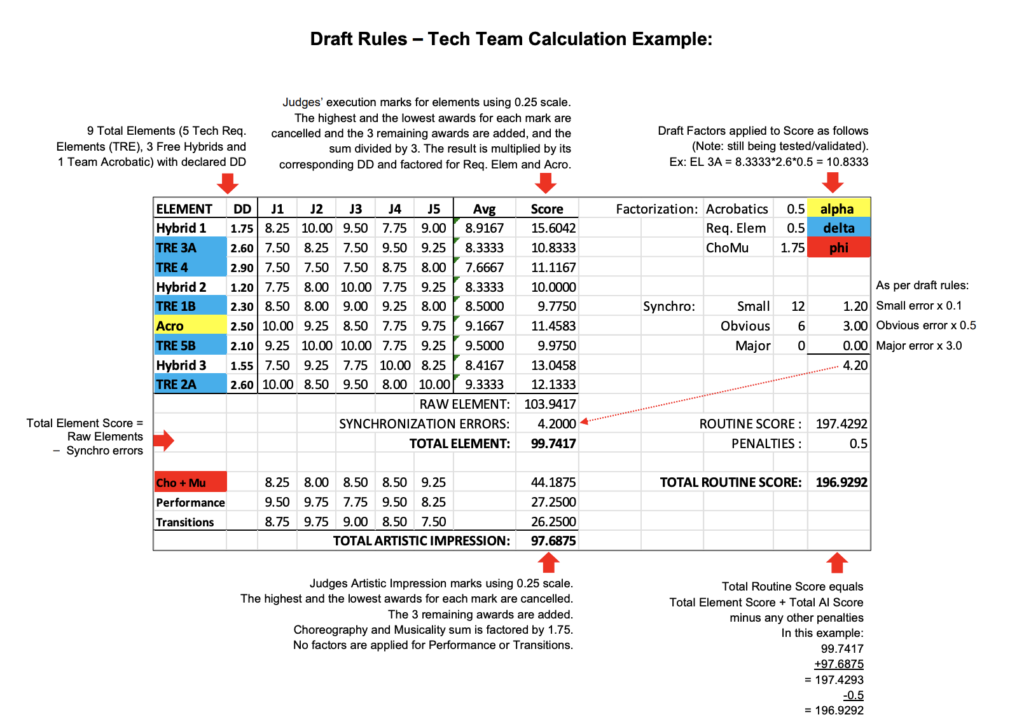
The elements panel judges the execution of everything given a point value. This means that the judges give a separate score for each hybrid or lift completed in the routine. They judge how clean each movement is and the athlete’s height in the water (the amount of their body that is not submerged). Height, specifically, is judged using charts that dictate which point value should be given for different water levels in different moves. Scores are still given on a scale from 1-10, but now in 0.25 increments.
Artistic impression encompasses many things, including choreography and musicality, performance, and transitions. Choreography and musicality is a measure of the crafting of the routine, scoring the creativity and variety of movements as well as how well the movements flow and fit with the music. Performance encompasses how the athlete presents themselves during the routine, judging their facial expression, body language, and confidence. Lastly, transitions is all about mastery over strokes, considering the purposefulness and execution of all above-water movements. Artistic impression judges give 3 different scores to each routine, one per category above. The main changes here are minute; the walkout (how the athletes walk onto the pool deck and dive into the pool) is now judged, and again, scores are still between 1-10 but now in 0.25 increments.
Synchronization judges are a new addition to the sport—synchronization was always important, but now it is directly judged. The synchronization technical control panel counts the number of errors, keeping a tally of the number of points to subtract based on the severity of the mistakes: minor errors remove 0.1, obvious errors remove 0.5, and major errors remove 3.0 points.
Finally, the difficulty technical control panel, often referred to as tech controllers, serves to check the accuracy of the declared difficulty and the coach card. The declared difficulty is the stated sum of all points accumulated during the routine, and the coach card is a document that breaks down the declared difficulty into the point value for each element, specifying the exact movements being completed to earn each score. The tech controllers examine this card during the routine, checking that the athletes are properly completing each declared movement; if any athlete does not effectively complete a declared movement, the point value for the entire element is reduced to 0.5. The updated point value (either 0.5 or the declared value) for each hybrid and acrobatic is then added up to form the actual difficulty of the routine.
Finally, routines may earn penalties for a few different things, including having too few people (fewer than 8 in a team routine), touching the bottom of the pool, or having an incorrect amount of hybrids or acrobatics. The new addition here is the penalty for exceeding the limiting amount of hybrids or acrobatics, as the standard number didn’t exist before.
Calculation of Scores
The bulk of a team’s score in the new rules comes from their difficulty score; the difficulty of each hybrid or acrobatic is multiplied by its corresponding execution score, greatly increasing its magnitude of importance. To this, the artistic score is added: a sum of the scores for choreography and musicality, performance, and transitions. Lastly, any synchronization errors and penalties given will be subtracted. In this total score, you might see another big change: they are no longer capped at only 100 points. Because difficulty scores experience no limit and are no longer on the scale of 1-10, the majority of routines are receiving scores much higher than only 100 points, with many even reaching the 200s and beyond.
Conclusion
Ultimately, the new rules in artistic swimming have created a more standardized way to judge the sport, although they may also limit artistry at times. The rules have their pros and their cons, but they continue to evolve every year, keeping the goal of finding the right balance that truly represents the beauty of this sport.
References
“Artistic Swimming Rules.” World Aquatics, www.worldaquatics.com/artistic-swimming/rules.
Marmet, Christina. “What Is Changing with the New Artistic Swimming Rules?” Inside
Synchro, 25 Sept. 2022,
insidesynchro.org/2022/09/25/what-is-changing-with-the-new-artistic-swimming-rules/.
Katja Vujić. “2024 Olympics: What to Know about Synchronized Swimming.” The Cut, 24 Jan.
2024,
www.thecut.com/2024/01/why-you-should-watch-synchro-at-the-paris-olympics.html.
“2024 World Aquatics Championships.” Usaartisticswim.org, 3 Nov. 2023,
www.usaartisticswim.org/2024-world-aquatics-championships.